
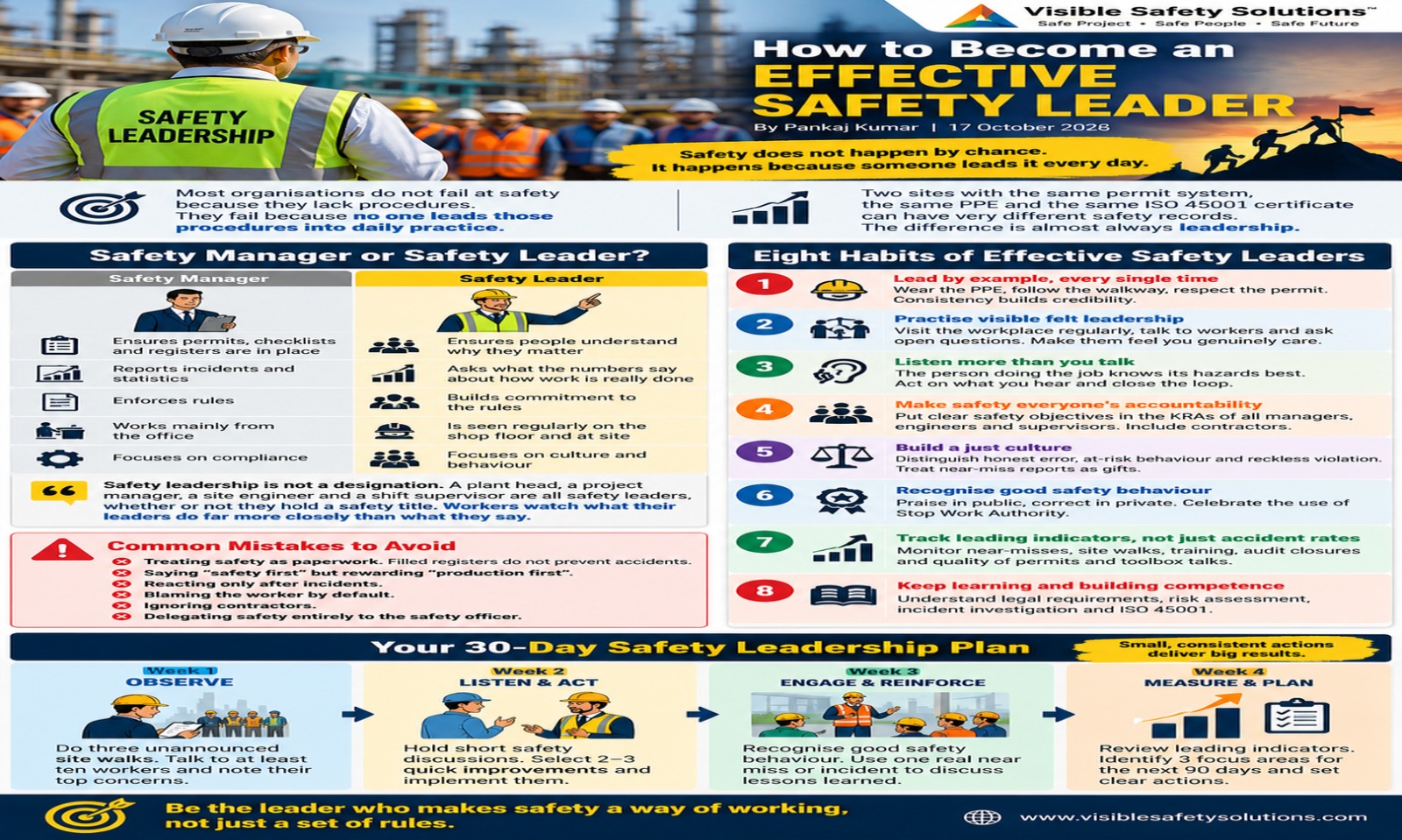
Most organisations do not fail at safety because they lack procedures. They fail because no one leads those procedures into daily practice.
In almost three decades of safety audits across refineries, metro projects, pharma plants and construction sites, one pattern repeats. Two sites with the same permit system, the same PPE and the same ISO 45001 certificate can have very different safety records. The difference is almost always leadership.
This article explains what effective safety leadership looks like in practice, the habits that build it, the mistakes that undermine it, and a simple 30-day plan to start today.
Safety leader or safety manager?
A safety manager maintains the system. A safety leader makes people want to follow it. Both roles matter, but they are not the same.
|
Safety manager |
Safety leader |
|
Ensures permits, checklists and registers are in place |
Ensures people understand why they matter |
|
Reports incidents and statistics |
Asks what the numbers say about how work is really done |
|
Enforces rules |
Builds commitment to the rules |
|
Works mainly from the office |
Is seen regularly on the shop floor and at site |
|
Focuses on compliance |
Focuses on culture and behaviour |
Safety leadership is not a designation. A plant head, a project manager, a site engineer and a shift supervisor are all safety leaders, whether or not they hold a safety title. Workers watch what their leaders do far more closely than what they say.
Eight habits of effective safety leaders
1. Lead by example, every single time
If the manager walks into a hard-hat zone without a helmet "just for two minutes", the message is clear: rules are optional. Wear the PPE, follow the walkway, respect the permit. Consistency builds credibility faster than any speech.
2. Practise visible felt leadership
Go to the workplace regularly, not only after an incident. Walk the site, talk to workers, and ask open questions:
• "What is the most dangerous part of your job today?"
• "What would make this task safer?"
• "Is there anything stopping you from working safely?"
Workers must not only see you. They must feel that you genuinely care.
3. Listen more than you talk
The person doing the job knows its hazards best. Act on what you hear and close the loop. When a worker sees their suggestion implemented, you gain one more safety champion.
4. Make safety everyone's accountability
Safety is a line responsibility, not just the safety department's job. Put clear safety objectives in the KRAs of managers, engineers and supervisors. Include contractors, because they often carry the highest risk.
5. Build a just culture
Blame drives reporting underground. Distinguish honest error from at-risk behaviour and from reckless violation, and respond to each fairly. Treat near-miss reports as gifts. They are free lessons before someone gets hurt.
6. Recognise good safety behaviour
Praise in public, correct in private. Recognise the worker who stopped a job because conditions were unsafe. Using Stop Work Authority should be celebrated, never penalised.
7. Track leading indicators, not just accident rates
A low accident rate does not prove a safe workplace. Monitor what predicts performance:
• Near-misses reported and closed
• Safety observations and site walks by leaders
• Training completion and competence assessments
• Audit findings closed on time
• Quality of permits and toolbox talks
8. Keep learning and building competence
Understand the legal framework, including the Factories Act, the OSH Code 2020, BOCW rules and relevant IS standards. Learn risk assessment, incident investigation and ISO 45001. A leader who understands the technical side earns respect from engineers and workers alike.
Common mistakes to avoid
• Treating safety as paperwork. Filled registers do not prevent accidents. Verify that what is written is what is done.
• Saying "safety first" but rewarding "production first". When targets are squeezed, workers notice which one really wins.
• Reacting only after incidents. Leadership that appears only after a fatality has already lost credibility.
• Blaming the worker by default. Most incidents have system causes: poor planning, inadequate training, unsafe design or time pressure.
• Ignoring contractors. On many Indian sites, contract workers face the highest exposure and receive the least attention.
• Delegating safety entirely to the safety officer. The safety officer advises. Line management leads.
Your 30-day safety leadership plan
You do not need a new budget to start. You need four weeks of deliberate action.
1. Week 1: Observe. Do three unannounced site walks. Talk to at least ten workers and note their top concerns.
2. Week 2: Act visibly. Fix two concerns workers raised and tell them it was their suggestion. Personally attend one toolbox talk.
3. Week 3: Set accountability. Add one measurable safety objective to each supervisor's goals. Start tracking near-miss reporting and closure.
4. Week 4: Recognise and review. Publicly recognise one worker or team for safe behaviour. Review what changed and plan the next 90 days.
Repeat the cycle. Culture changes through consistent small actions, not one-time campaigns.
Conclusion: safety leadership is a daily choice
Effective safety leaders are not born. They are built through daily choices: wearing the helmet, stopping the unsafe job, listening to the worker and fixing what they said. Systems give you the structure. Leadership brings that structure to life.
Every leader in your organisation either strengthens or weakens your safety culture every day. The question is which one.
How Visible Safety Solutions can help
Visible Safety Solutions (VSS) is an ISO 9001, 14001 and 45001 certified EHS consultancy with over 28 years of experience. We help organisations build safety cultures that work on the ground through:
• Safety leadership and behaviour-based safety training for managers and supervisors
• Safety audits, including fire and life safety, electrical safety and road safety audits
• ISO 45001 implementation and internal audits
• Contractor safety management and site safety training
To strengthen safety leadership in your organisation, contact us at www.visiblesafetysolutions.com.
About the author: Pankaj Kumar is the Principal Consultant and CEO of Visible Safety Solutions and founder of the Safety Engineers Association of India (SEAI). He is a CertIOSH (UK) professional, ISO 45001 Lead Auditor and author of an Industrial Safety Engineering textbook.