
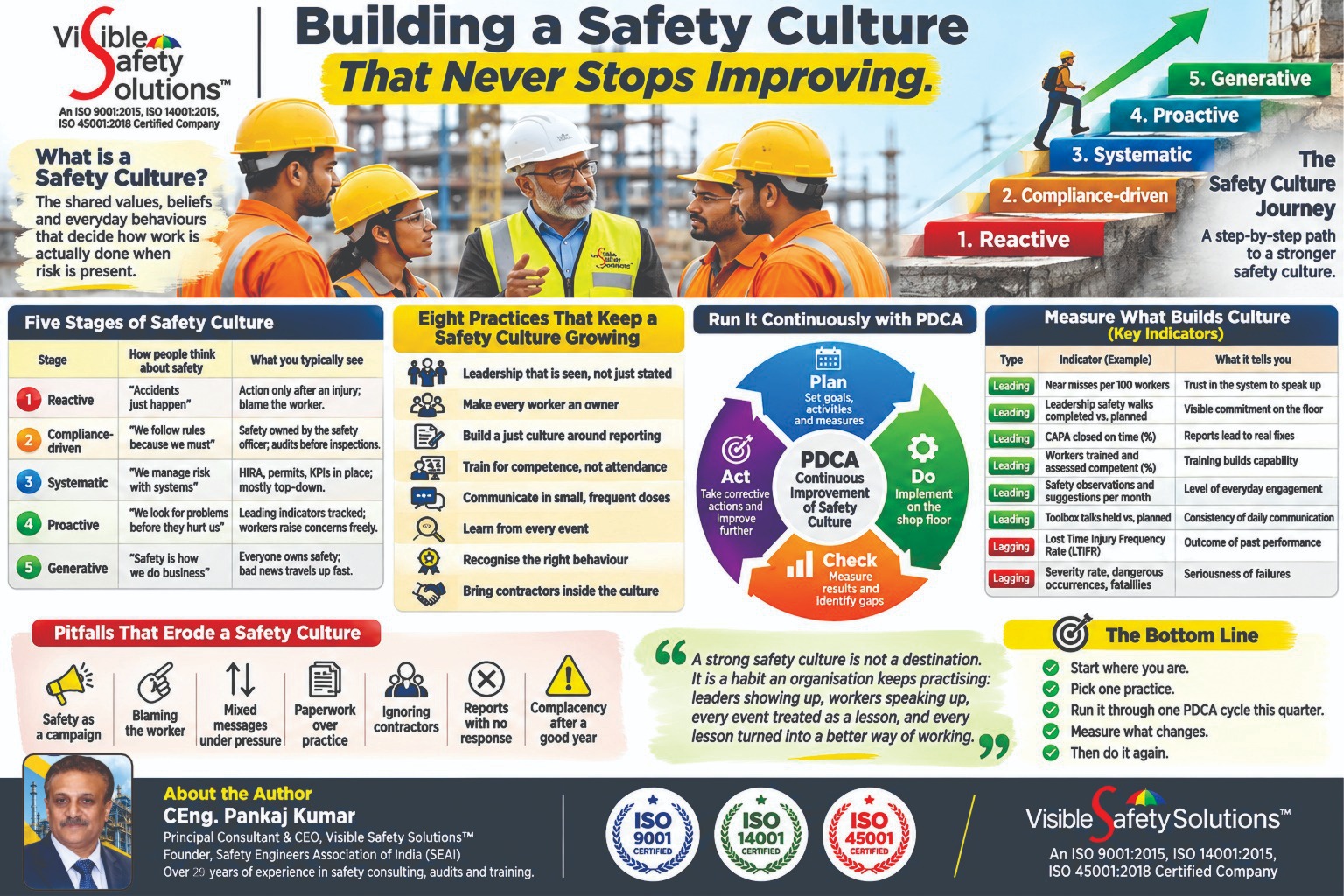
A safety culture is not built by a launch event or a poster campaign. It is built the way fitness is built: through small, repeated actions that leaders and workers keep doing long after the novelty wears off.
Most organisations already have the hardware of safety: a policy, a safety committee, PPE, permits, and a register of statutory compliances under the Factories Act or the OSH Code, 2020. Yet incidents still happen at sites that look compliant on paper. The gap is almost always cultural. It lives in what people do when no one is watching, what a supervisor says when production is behind schedule, and whether a young worker feels safe enough to say "stop".
This article sets out how to build that culture and, more importantly, how to keep it growing year after year.
What safety culture really means
Safety culture is the shared set of values, beliefs and everyday behaviours that decide how work is actually done when risk is present. Put simply, it is "the way we do things here" when the job is hazardous.
It shows up in small moments: a supervisor who halts a lift because the rigging looks wrong, a contractor who reports a near miss without fear of blame, a manager who asks about yesterday's permit before asking about yesterday's output.
Cultures do not jump from weak to excellent. They climb through recognisable stages. Knowing where your site stands tells you what to work on next.
|
Stage |
How people think about safety |
What you typically see |
Next step to climb |
|
1. Reactive |
"Accidents just happen" |
Action only after an injury; blame the worker |
Leaders commit visibly; basic rules enforced |
|
2. Compliance-driven |
"We follow rules because we must" |
Safety owned by the safety officer; audits before inspections |
Train supervisors; start near-miss reporting |
|
3. Systematic |
"We manage risk with systems" |
HIRA, permits, KPIs in place; mostly top-down |
Involve workers in risk assessment and audits |
|
4. Proactive |
"We look for problems before they hurt us" |
Leading indicators tracked; workers raise concerns freely |
Peer observation; learning from every event |
|
5. Generative |
"Safety is how we do business" |
Everyone owns safety; bad news travels up fast |
Sustain, benchmark, and keep challenging complacency |
In our experience, many worksites sit between stages 2 and 3. The aim of continuous development is to keep moving one step at a time, and never to slide back.
Eight practices that keep a safety culture growing
1. Leadership that is seen, not just stated
Workers judge priorities by what leaders do, not by what the policy says. A plant head who walks the floor every week, wears full PPE without exception, and stops a job that looks unsafe sends a stronger message than any circular.
• Schedule regular Gemba or safety walks for senior managers, with a fixed calendar.
• Open every review meeting with safety, not production.
• Allocate budget for safety improvements without making teams fight for it.
2. Make every worker an owner
Safety cannot be the safety department's job alone. Ownership grows when people help decide how risks are controlled in their own area.
• Involve workers in HIRA and Job Safety Analysis for the tasks they perform.
• Rotate workers through the safety committee, not just supervisors.
• Give every employee clear authority to stop unsafe work, and back them when they use it.
3. Build a just culture around reporting
If reporting a near miss leads to blame, people stop reporting. Then the organisation goes blind to its own warning signs.
• Separate honest errors from reckless or deliberate violations, and treat each fairly.
• Make reporting easy: a simple card, a QR code, or a WhatsApp number.
• Close the loop. Tell the reporter what was done, within a fixed number of days.
4. Train for competence, not attendance
A signed attendance sheet proves presence, not capability. Training should change what people can actually do on the job.
• Use hands-on demonstrations, mock drills and toolbox talks in the local language.
• Assess competence after training, especially for permit issuers, riggers, scaffolders and electricians.
• Refresh training at set intervals and whenever a process or hazard changes.
5. Communicate in small, frequent doses
Culture is reinforced by daily conversation more than by annual events.
• Hold a five-minute toolbox talk before every shift, linked to that day's task.
• Share lessons from recent incidents, inside and outside the company.
• Use visual management: safety boards, colour coding and pictorial signage.
6. Learn from every event
Every incident, near miss and unsafe condition is free information about how the system can fail.
• Investigate to find root causes, using methods such as 5-Why or Fishbone, rather than stopping at "worker negligence".
• Track corrective and preventive actions (CAPA) to closure, with owners and dates.
• Share learnings across sites and contractors, not just within the affected team.
7. Recognise the right behaviour
People repeat what gets noticed. Recognition should reward safe behaviour and proactive effort, not just injury-free days.
• Recognise good near-miss reports, safety suggestions and interventions.
• Avoid rewards tied only to zero injuries; they can quietly discourage reporting.
• Keep recognition public, prompt and personal.
8. Bring contractors inside the culture
On many Indian sites, most of the high-risk work is done by contract workers. A culture that stops at the company payroll has a hole in the middle.
• Include safety performance in contractor selection and evaluation.
• Give contract workers the same induction, toolbox talks and stop-work authority.
• Hold joint safety meetings with contractor supervisors.
Keep it continuous: run culture through PDCA
The practices above only build culture if they are repeated and refined. The simplest engine for this is the Plan-Do-Check-Act (PDCA) cycle, the same logic that underpins ISO 45001.

PDCA cycle for safety culture · 4 stages
Each turn of the cycle should be small enough to finish in a quarter. Over two or three years, these small turns add up to a visible shift in how people think and act.
Measure what builds culture, not only what hurts
Injury rates tell you what already went wrong. Culture is better tracked with leading indicators that show whether the right activities are happening before anyone gets hurt.
|
Type |
Indicator |
What it tells you |
|
Leading |
Near misses reported per 100 workers |
Whether people trust the system enough to speak up |
|
Leading |
Leadership safety walks completed vs. planned |
Whether commitment is visible on the floor |
|
Leading |
CAPA closed on time (%) |
Whether reports lead to real fixes |
|
Leading |
Workers trained and assessed as competent (%) |
Whether training builds capability |
|
Leading |
Safety observations and suggestions per month |
Level of everyday engagement |
|
Leading |
Toolbox talks held vs. planned |
Consistency of daily communication |
|
Lagging |
Lost Time Injury Frequency Rate (LTIFR) |
Outcome of past performance |
|
Lagging |
Severity rate, dangerous occurrences, fatalities |
Seriousness of failures |
A rising near-miss count is often good news in the early years. It usually means reporting is improving, not that the site is getting more dangerous.
Run a short perception survey once a year as well. Asking workers, supervisors and managers the same questions often reveals a large gap between how leaders think safety is going and how the floor experiences it.
Pitfalls that quietly erode a safety culture
|
Pitfall |
Why it hurts |
What to do instead |
|
Safety as a campaign |
Energy fades after Safety Week |
Build safety into daily routines and meetings |
|
Blaming the worker |
Hides system failures and stops reporting |
Investigate the system; apply a just culture |
|
Mixed messages under pressure |
"Safety first" collapses when targets are tight |
Leaders hold the line, especially when it costs |
|
Paperwork over practice |
Permits signed without checking the site |
Verify on the floor; audit permit quality |
|
Ignoring contractors |
High-risk work stays outside the culture |
Same standards, training and voice for all |
|
Reports with no response |
Workers conclude speaking up is pointless |
Close the loop on every report |
|
Complacency after a good year |
Zero injuries mistaken for zero risk |
Keep looking for weak signals and near misses |
A culture is never finished
A strong safety culture is not a destination you reach and then certify. It is a habit an organisation keeps practising: leaders showing up, workers speaking up, every event treated as a lesson, and every lesson turned into a better way of working.
Start where you are. Pick one practice from this article, run it through one Plan-Do-Check-Act cycle this quarter, and measure what changes. Then do it again. That is how good sites become great, and how great sites stay that way.
About the author: CEng. Pankaj Kumar is Principal Consultant & CEO of Visible Safety Solutions™ (VSS™), an ISO 9001/14001/45001-certified EHS consultancy based in New Delhi, with over 28 years of experience in safety consulting, audits and training. He is also the founder of the Safety Engineers Association of India (SEAI). To discuss a safety culture assessment for your organisation, visit www.visiblesafetysolutions.com.