
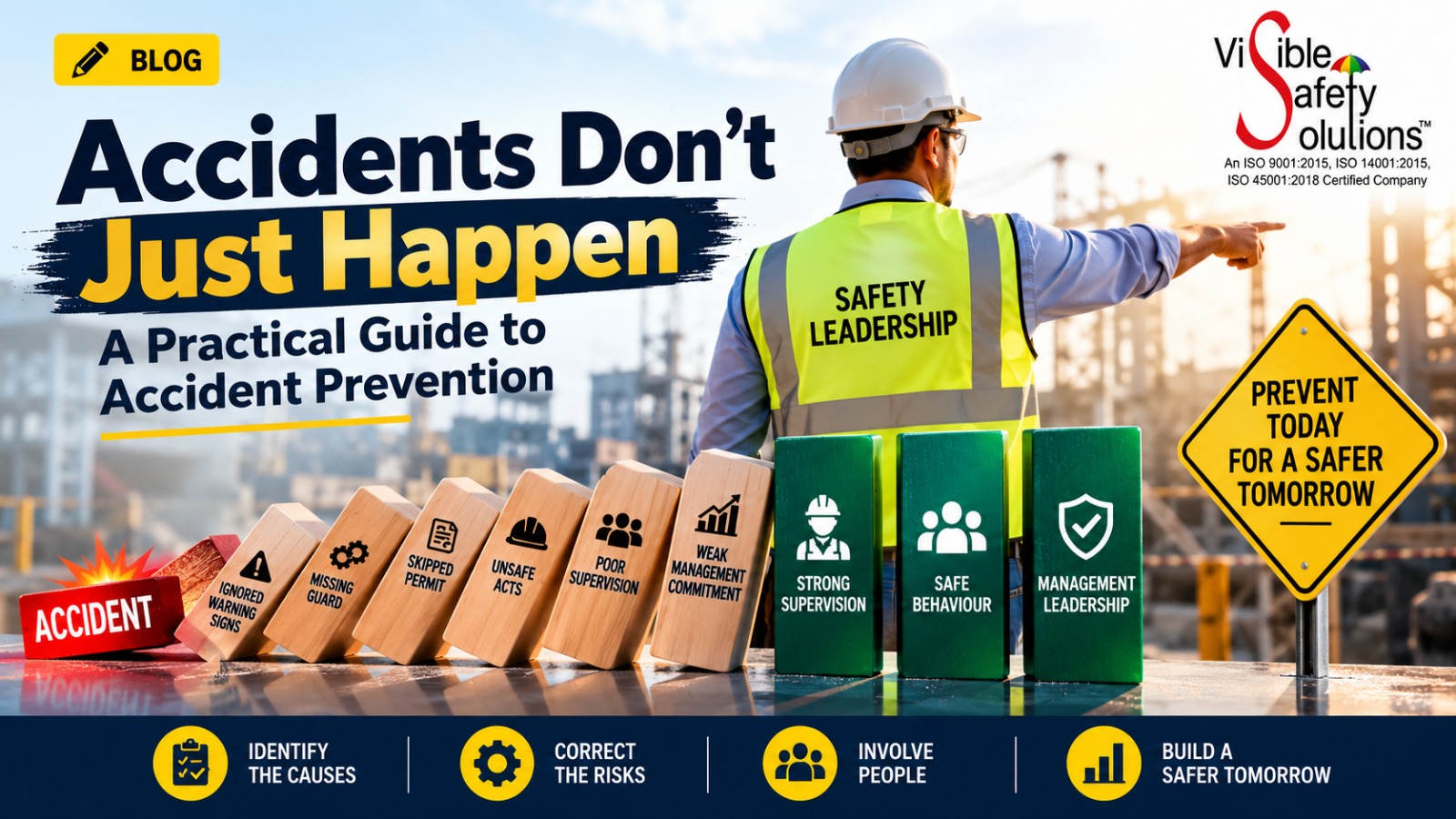
Every accident has a cause, and every cause can be found and fixed. That single idea is the foundation of accident prevention.
We often hear "it was just bad luck" after a fall from height, a hand caught in a machine, or a fire in a store. In nearly every case we investigate, the warning signs were visible long before the incident: a missing guard, a skipped permit, a supervisor who looked away. Accidents are not acts of fate. They are the end of a chain of small, preventable failures.
This article sets out how owners and managers can break that chain, starting at the top of the organisation.
Start with belief: all accidents are preventable
When a company's injury numbers start climbing, the instinct is to buy more PPE or run another training session. Those help, but they are not the first step. The first step is a management philosophy that says, without exception, that accidents can be prevented.
That belief changes behaviour. A manager who accepts some injuries as "part of the job" will tolerate the conditions that cause them. A manager who believes every injury is avoidable will ask why it happened, and will not rest until the cause is removed.
Three commitments follow from this philosophy:
1. Investigate every accident and injury, however minor, so it does not happen again.
2. Correct unsafe conditions and unsafe acts immediately, not at the next review meeting.
3. Treat skilled workers as the investment they are. Every day a trained worker is off the job is lost production, and when that absence was avoidable, the loss is doubled.
Supervisors make or break the programme
The supervisor is the link between the safety policy on paper and the work on the shop floor. Workers watch what their supervisor allows, not what the notice board says.
A good supervisor leads the crew and stops anyone from taking chances that could cause injury. Workers, in turn, are expected to follow instructions and do the job safely and on time. Both sides share responsibility.
One rule must be clear to everyone: nobody trades safety for output, and nobody uses safety as an excuse to stop output. Production and safety are not rivals. A job done safely is a job done well, and a job done well is done safely.
Expect resistance, and plan for it
People want to be safe, yet many enjoy a little risk. They want progress, yet dislike change. New safety rules, a new permit system or mandatory harness use will meet push-back, especially from experienced workers who have "always done it this way".
Resistance usually comes from not understanding. Supervisors can reduce it by:
• Announcing changes in advance, and explaining exactly how they affect each worker's routine.
• Explaining the why, not only the what. The reasons are personal: avoiding injury, avoiding lost wages, and avoiding a hospital bed.
• Showing, not just telling. Workers act on what they see around them. A demonstration, a near-miss story from their own site, or a supervisor doing it right speaks louder than a circular.
Management sets the tone
Safety culture flows downward. When senior managers wear their helmet and safety shoes on the plant floor, follow the work permit, and insist on clean aisles, workers notice and follow.
The opposite is just as powerful. A plant head who walks through a hard-hat area bare-headed, or ignores spilled oil near a staircase, sends a clear message: safety is for show. Once workers believe that, indifference spreads, and the injury rate will rise.
On audits we often find the quickest indicator of a site's safety culture is not its documentation. It is how the senior team behaves during the walk-through.
Put it in writing: the safety policy
A written safety policy, signed by the owner and top management and communicated to every employee, turns intent into commitment. It tells workers that management takes their safety seriously. It also tells supervisors that their safety efforts have backing from the top.
In India this is not optional for many organisations. The Factories Act, 1948 required a written safety policy for factories carrying out hazardous processes, and the Occupational Safety, Health and Working Conditions Code, 2020 places clear duties on employers to provide a safe workplace. ISO 45001 also makes a documented OH&S policy and visible leadership commitment a core requirement.
An effective policy rests on a few principles:
1. People are the organisation's most valuable resource, and protecting them comes first.
2. Injuries and occupational illnesses are preventable.
3. Working safely is a condition of employment, for everyone.
4. Management regularly checks how safely work is actually being done.
5. Every worker is trained for every task before doing it.
6. Unsafe conditions and unsafe acts are corrected without delay.
7. Discipline is fair, consistent and aimed at correction, not punishment.
8. Every accident, injury, illness and near miss is investigated promptly.
9. Workers are encouraged to raise hazards, and are thanked for doing so.
10. Managers follow every safety rule they expect others to follow.
A policy only works if it is enforced. If workers see supervisors ignoring the rules, or looking the other way, the signed document on the wall becomes meaningless.
The building blocks of a complete programme
Policy and leadership are the foundation. On top of them sit practical elements that depend on one another; weakness in one undermines the rest.
|
Element |
What it does |
|
Accident investigation |
Finds root causes so the same accident does not repeat |
|
Safety inspections |
Spots hazards before they cause harm; needs trained eyes that know what to look for |
|
Job hazard analysis (JHA/HIRA) |
Breaks each hazardous task into steps and controls the risk at each one |
|
Training |
Built on the JHA, so workers learn the real hazards of their own job |
|
Ergonomics |
Reduces strain from repetitive motion and poor posture |
|
Fire prevention |
Housekeeping, inspections and constant vigilance |
|
Occupational health and chemical safety |
Hazard communication, SDS, exposure monitoring, respiratory protection |
|
PPE |
The last line of defence, after engineering and administrative controls |
|
Emergency response |
A tested plan that limits injury and damage when things go wrong |
|
Safety committee |
Gives workers a voice and spreads ownership |
|
Records and statistics |
Show whether performance is improving, and what accidents really cost |
|
Rule enforcement and recognition |
Consistent discipline balanced with positive reinforcement |
|
First aid and medical support |
Trained responders and equipment close to the work |
|
Drug and alcohol awareness |
Identifies impairment and supports treatment |
|
Office and off-the-job safety |
Extends the safety habit to every hour of the day |
|
Programme evaluation |
Periodic review to find gaps and keep improving |
System safety ties these together. It means thinking through hazards at every stage of a project, from design to commissioning to maintenance, instead of reacting after something goes wrong.
A checklist for owners and managers
Use this to see where your organisation stands today:
• ☐ We have a written safety policy, signed by top management and displayed in local languages.
• ☐ Every employee and contractor has been briefed on it.
• ☐ Senior managers follow every PPE and permit rule on the shop floor.
• ☐ Supervisors are trained and held accountable for safety in their area.
• ☐ Every accident and near miss is reported and investigated for root cause.
• ☐ Unsafe conditions are fixed within an agreed, tracked timeframe.
• ☐ Job hazard analyses exist for all hazardous tasks and drive our training.
• ☐ We have a tested emergency response plan and run regular drills.
• ☐ A safety committee with worker representatives meets regularly.
• ☐ We track injury rates and accident costs, and review them at management meetings.
If you cannot tick most of these boxes, your next accident is a matter of when, not if.
Frequently asked questions
Are all workplace accidents really preventable? Nearly all are. Investigations almost always trace an accident back to an unsafe condition, an unsafe act, or a gap in the management system, and each of these can be controlled.
Who is responsible for safety in a factory or site? The employer carries the legal duty, but responsibility is shared. Management sets policy and provides resources, supervisors enforce rules on the floor, and workers follow safe practices and report hazards.
Is a written safety policy mandatory in India? For many organisations, yes. Hazardous-process factories have long been required to maintain one, the OSH Code, 2020 sets employer safety duties, and ISO 45001 certification requires a documented OH&S policy.
What is the difference between an unsafe act and an unsafe condition? An unsafe act is something a person does, such as bypassing a machine guard. An unsafe condition is a hazard in the workplace, such as a missing guard or an oily floor. Prevention targets both.
How often should a safety programme be reviewed? At least once a year, and after any serious incident, major process change or new legal requirement. An independent external audit helps reveal blind spots.
Knowledge is only useful when it becomes action
Accident prevention is not a one-time campaign. It is a way of running a business: a clear belief from the top, a written policy, supervisors who enforce it, and a set of systems that find and remove hazards before they hurt someone.
Every organisation can start today. Sign the policy, walk the floor with fresh eyes, and fix the first unsafe condition you see.
Visible Safety Solutions™ (VSS™) is an ISO 9001, 14001 and 45001-certified EHS consultancy based in New Delhi, with 29+ years of experience in safety audits, HIRA, fire and life safety, electrical safety and safety training. To review your safety programme or build an accident prevention system for your site, visit www.visiblesafetysolutions.com.